



©
2001-2026
Molloy Sound and Video Contractors


Click
for the 2004 WKBR Reunion
N.H. Business Review - Jan. 28-Feb. 10, 2000
|
By Jack Kenny |

|
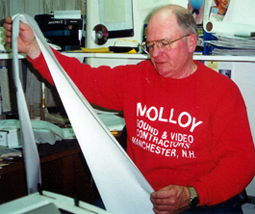
When Ronald Reagan uttered the famous line, "I am paying for this microphone, Mr. Green," it was Bob Molloy's microphone he was renting. That pivotal moment in the New Hampshire presidential primary campaign of 1980 is among the many memories Molloy has accumulated in his 24 years as president of Molloy Sound and Video Contractors in Manchester. "I wasn't going to turn off the microphone," he said, despite the order of debate moderator Jon Breen (not "Green"), then the editor of the Nashua Telegraph. "For one thing, I wouldn't have been that rude to a guest in our auditorium. And two, he was, in fact, paying for the microphone." Then, as now, there was a multi-candidate race among Republicans in the New Hampshire primary. Then, as now, two of them appeared to be in a tight race for the top spot, with the rest of the pack far behind in the polls. A few days before the primary, Reagan, the hero of the party's conservative ranks, and George Bush, winner of the Iowa caucus, were scheduled to meet in a one-on-one debate sponsored by the Nashua Telegraph. When the Federal Elections Commission ruled the newspaper couldn't sponsor the debate without including the other candidates, the Reagan campaign offered to pay for the event. |
 |
|
"It was total chaos," said Molloy, with Reagan continuing to talk and people in the audience shouting their opinions of Breen's effort to silence the former California governor. Eventually, order was restored, the other candidates left, and the two-way debate took place. But the confrontation over the microphone became the big news story. "Nobody remembered anything that was said in the debate," said Molloy, himself included. With the possible exception of reporters covering the campaigns on a daily basis, Molloy sees and hears more candidates more often than anyone. But he is busy tending to the sound, lighting and visual effects - not the content of the speeches or the debating points. "When they get up to the microphone to speak, my job is to make sure something comes out," he said. "After that, they're on their own." The lasting image of Reagan reminding the moderator who was paying for the microphone helped reinforce the candidate's reputation for toughness and a willingness to take a stand. "It showed he had some moxie, and I think people liked that," said Molloy. Reagan won the primary in a landslide a few days later and the rest, including Molloy's microphone, is history. "After Bill Clinton became president, Mrs. Reagan announced she wanted to have an exhibit called 'Our 42 Presidents," or something like that. She was looking for artifacts of each of the presidents." So the microphone, on loan from Molloy, is on display at the Reagan Library in California, in a section on the New Hampshire Primary. He will not tell who he favors in the current primary. "Whichever one spends the most money with me," he laughed. He has worked for presidential hopefuls of both major parties over the last seven New Hampshire primary campaigns, but he remembers them more for their personality traits than their political platforms. "Bob Dole was a very funny guy," he said, recalling witticisms he would hear from the former Sentate majority leader and 1996 Republican nominee. "I think if (his advisers) let him be himself instead of handling him, he would have been better off." Michael Dukakis, the Democratic nominee in 1998, was often concerned about the height of the lectern. About an hour before a speaking engagement at the Sheraton in Bedford, Molloy recalled, the height-challenged Massachusetts governor arrived to check out the platform. "Get me up or get it (the lectern) out!" he demanded. The problem was solved by placing a glass rack behind the lectern for Dukakis to stand on. During this primary season, Molloy has done more work for the Bush campaign than any other. "I've never seen anything like the crowds he gets," said Molloy. "It's like they've come out to see a movie star." He also says Bush's advance team is the best he's seen in his 24 years of work with political campaigns. "Here," he said, holding up several pages of a fax from the Bush campaign. "They tell you exactly where they're going to be and what their needs are." The Gore campaign, on the other hand, "is apt to waste a lot of your time over two or three days looking at different sites. Then they'll call the next day and say they've changed their mind." As busy as he is in the primary season, Molloy can afford to be selective about what jobs he'll take, particularly at the last minute. While Molloy spends most of his time at the job sites, his wife, Lorene, runs the office. Demand for the company's services comes from a variety of sources, including the TV networks seeking satellite feeds from campaign events. The company also was hired by C-Span for its telecast of the recent memorial service in Manchester for Union Leader publisher Nackey Loeb. "C-Span called and said unless we provided the lighting, they weren't going to do it. I said to Lorene, 'Gee, that's not much pressure, is it?" Before launching his own business in the mid-1970s, Molloy was technical director for Ralph Gottlieb, then owner of WKBR and WZID in Manchester and several other New Hampshire radio stations. It was at WKBR that he met a relatively obscure former governor of Georgia named Jimmy Carter. "Lucille Kelly brought him over to the station," said Molloy, recalling the late Manchester advertising executive and Democratic Party activist. "I said, 'Hello, pleased to meet you,' and went back to work. I really didn't think anything of it." Kelly, he said, was one of the people who helped the future president gain recognition in the Granite State. "She kept bringing 'Jimmy Who?' around until people knew who the hell he was." Molloy bought the old WKBR building by the Amoskeag Bridge a few years ago and renovated it, turning it into his own recording studio. Rehabbing buildings is a hobby, he said. "Give me a hammer and some nails and I'm like a kid in a sand box." At the height of the primary season, though, Molloy has little time for hobbies. He ahd his five-member crew are busy at campaign events, installing microphones and speakers, putting up "pipe and drape" backdrops, setting up the lighting, cameras and TV monitors. It is the same range of services he provides for his other clients, including corporations and municipalities. He is often busy at town meeting time, when overflow crowds require closed-circuit telecasts for those unable to get into a town hall meeting room or school auditorium. Sometimes getting access to the building in time to set up is a problem, Molloy said. He recalled a school district meeting in Bedford a few years ago when the question of building a local high school was on the agenda. A large crowd was expected, and video monitors and extra microphones would be need to allow citizens to participate from several locations within the building. "They had an in-house cable system, but it didn't work," Molloy said. "We basically had to wire the whole school building that day." Since it was a school day, Molloy and his crew normally would not have had a chance to do their wiring and set-up work until late in the day. "Fortunately, there was a snowstorm, and they called off school that day, though they still had the meeting that night. That meant we had all day to wire the building. So there is a God, you see," he added with a smile. Molloy makes a point of not letting his seasonal political work take precedence over the needs of his year-round clients. One corporate client, he said, asked him how he was able to respond so quickly to a request for service, given all the political activity that was going on. "I told him, 'You guys are my bread and butter. These guys go away in a couple of weeks.'" The primary creates "a nice blip on the charts," he said, "but my regular clients come first." Still, he enjoys the extra excitement every few years. "It's not something you'd want to do 365 days a year, but it's nice to have the New Hampshire primary every four years. Just about the time you feel you've had enough of (the campaigns), they go away." -Reprinted with permission of N.H. Business Review |